Remote construction projects often face unique challenges that traditional concrete production methods cannot easily solve. Limited infrastructure, difficult transportation conditions, shortage of skilled workers, and unstable material supply can significantly increase construction costs and reduce project efficiency.
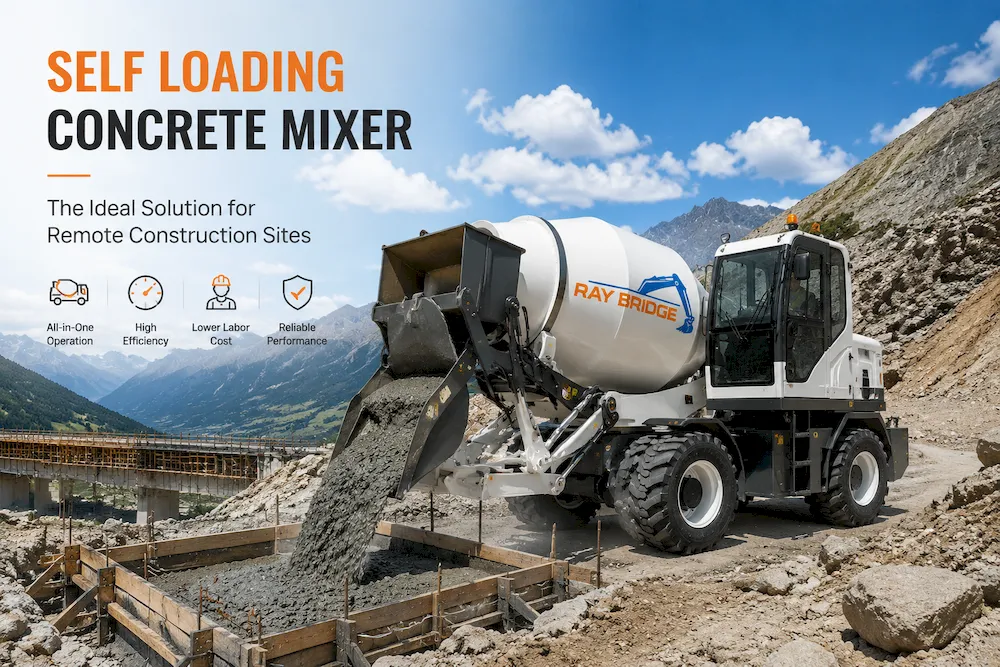
A self loading concrete mixer provides an efficient solution by combining material loading, weighing, mixing, transportation, and concrete discharge into a single machine. This all-in-one design allows contractors to produce fresh concrete directly at the construction site, even in remote areas where traditional concrete supply systems are difficult to establish.
This article explains why self loading concrete mixers are becoming an ideal choice for remote construction sites and how they help improve productivity, reduce costs, and simplify concrete production.
What Is a Self Loading Concrete Mixer?
A self loading concrete mixer is a multi-functional construction machine that integrates several operations into one unit:
- Aggregate loading
- Automatic weighing
- Cement and water mixing
- Concrete transportation
- Concrete discharge
Unlike traditional concrete mixer trucks that rely on external concrete plants or loading equipment, self loading concrete mixers can independently complete the entire concrete production process.
The operator can drive the machine to the material storage area, load aggregates with the front bucket, mix concrete inside the drum, and transport the finished concrete directly to the working location.
This makes it especially suitable for projects where mobility and flexibility are essential.
Why Are Remote Construction Sites Challenging?
Remote construction locations usually have several difficulties that affect traditional concrete production.
Limited Access to Concrete Supply
Many remote areas do not have nearby ready-mix concrete plants.
Examples include:
- Mountain construction projects
- Rural infrastructure development
- Mining sites
- Remote road projects
- Small-scale building projects
Transporting ready-mix concrete over long distances can lead to:
- Higher transportation costs
- Longer delivery times
- Reduced concrete quality due to delays
A self loading concrete mixer solves this problem by producing concrete directly on-site.
Difficult Transportation Conditions
Remote construction sites often have:
- Poor road conditions
- Long transportation distances
- Uneven terrain
- Limited access routes
Large concrete trucks may struggle to reach these locations.
A self loading concrete mixer is designed for mobility and can operate in challenging environments thanks to:
- Four-wheel drive systems
- Strong chassis design
- High ground clearance
- Flexible steering capability
This allows operators to move efficiently between different working areas.
1. All-in-One Concrete Production Solution
One of the biggest advantages of a self loading concrete mixer is that it combines multiple machines into one.
Traditional concrete production may require:
- Loader for aggregate handling
- Concrete batching plant
- Mixer equipment
- Transportation vehicles
A self loading concrete mixer integrates these functions into one machine.
Complete Working Process
The typical operation includes:
- Loading raw materials with the front bucket
- Automatically weighing aggregates
- Adding cement and water according to the required ratio
- Mixing concrete during transportation
- Discharging concrete at the construction location
This significantly simplifies the construction process and reduces equipment requirements.
2. Reduce Labor Costs and Improve Efficiency
Labor availability is often a major challenge in remote areas.
Traditional concrete production requires multiple workers to manage:
- Material loading
- Mixing operations
- Transportation
- Quality control
A self loading concrete mixer reduces manpower requirements because one operator can complete multiple tasks.
Benefits include:
- Lower labor costs
- Faster concrete production
- Reduced coordination requirements
- Higher construction efficiency
For small and medium-sized contractors, this can provide a significant economic advantage.
3. Produce Fresh Concrete Anytime and Anywhere
Concrete quality depends heavily on mixing time and transportation distance.
When concrete is transported over long distances:
- Setting time may become difficult to control
- Quality may decrease
- Additional additives may be required
A self loading concrete mixer allows contractors to produce fresh concrete directly at the job site.
Advantages include:
- Better concrete consistency
- Flexible production schedule
- Reduced material waste
- Improved construction quality
This is particularly valuable for projects with changing concrete requirements.
4. Ideal for Infrastructure and Remote Projects
Self loading concrete mixers are widely used in various remote construction applications.
Road Construction
Remote road projects often require concrete supply in areas without established infrastructure.
Applications include:
- Road foundations
- Bridge approaches
- Drainage construction
- Road repair projects
Rural and Agricultural Construction
In rural areas, self loading concrete mixers can support:
- Farm buildings
- Irrigation systems
- Storage facilities
- Agricultural infrastructure
Their mobility allows operators to work across large areas efficiently.
Mining and Industrial Projects
Mining areas often have challenging environments and limited access.
Self loading concrete mixers can be used for:
- Site foundations
- Equipment bases
- Infrastructure construction
- Maintenance projects
5. Lower Overall Project Costs
Although the initial investment of a self loading concrete mixer may be higher than some traditional equipment, the total ownership cost can be lower.
Cost-saving advantages include:
Reduced Equipment Investment
One machine replaces several pieces of equipment, reducing the need for:
- Additional loaders
- Separate mixers
- Concrete transportation vehicles
Lower Transportation Expenses
Producing concrete on-site eliminates long-distance concrete delivery costs.
Improved Project Scheduling
Contractors are less dependent on external concrete suppliers and can control production according to project requirements.
This helps avoid delays caused by supply shortages.
6. Flexible Operation for Different Construction Conditions
Modern self loading concrete mixers are designed to adapt to various working environments.
Important features include:
Four-Wheel Drive Capability
Provides:
- Better traction
- Improved stability
- Stronger off-road performance
Compact Design
Compared with traditional concrete plants, self loading mixers require less space.
They are suitable for:
- Small construction sites
- Narrow working areas
- Temporary projects
Multi-Function Operation
A single machine can support different project stages, making it a practical investment for contractors who handle various construction tasks.
7. What Should You Consider When Buying a Self Loading Concrete Mixer?
Before purchasing, contractors should evaluate several important factors.
Mixing Capacity
Choose a model based on daily concrete requirements.
Consider:
- Project scale
- Production demand
- Working schedule
Engine Performance
A reliable engine ensures:
- Stable operation
- Fuel efficiency
- Better performance in difficult environments
Hydraulic System
The hydraulic system affects:
- Loading speed
- Mixing operation
- Discharge efficiency
A high-quality hydraulic system improves productivity and reliability.
After-Sales Support
For remote projects, supplier support is especially important.
Consider:
- Spare parts availability
- Technical assistance
- Warranty service
- Operator training
Conclusion
For remote construction sites, a self loading concrete mixer provides an efficient, flexible, and cost-effective concrete production solution.
By combining loading, weighing, mixing, transportation, and discharge functions into one machine, it helps contractors overcome challenges caused by limited infrastructure, difficult transportation, and labor shortages.
Whether used for road construction, rural development, mining projects, or infrastructure expansion, self loading concrete mixers allow contractors to produce high-quality concrete anytime and anywhere.
For companies working in challenging environments, investing in a reliable self loading concrete mixer can improve productivity, reduce operating costs, and create long-term value for construction projects.